

What Makes a High-Performance MgO-C Brick? The Role of Magnesia, Graphite and Microstructure Design
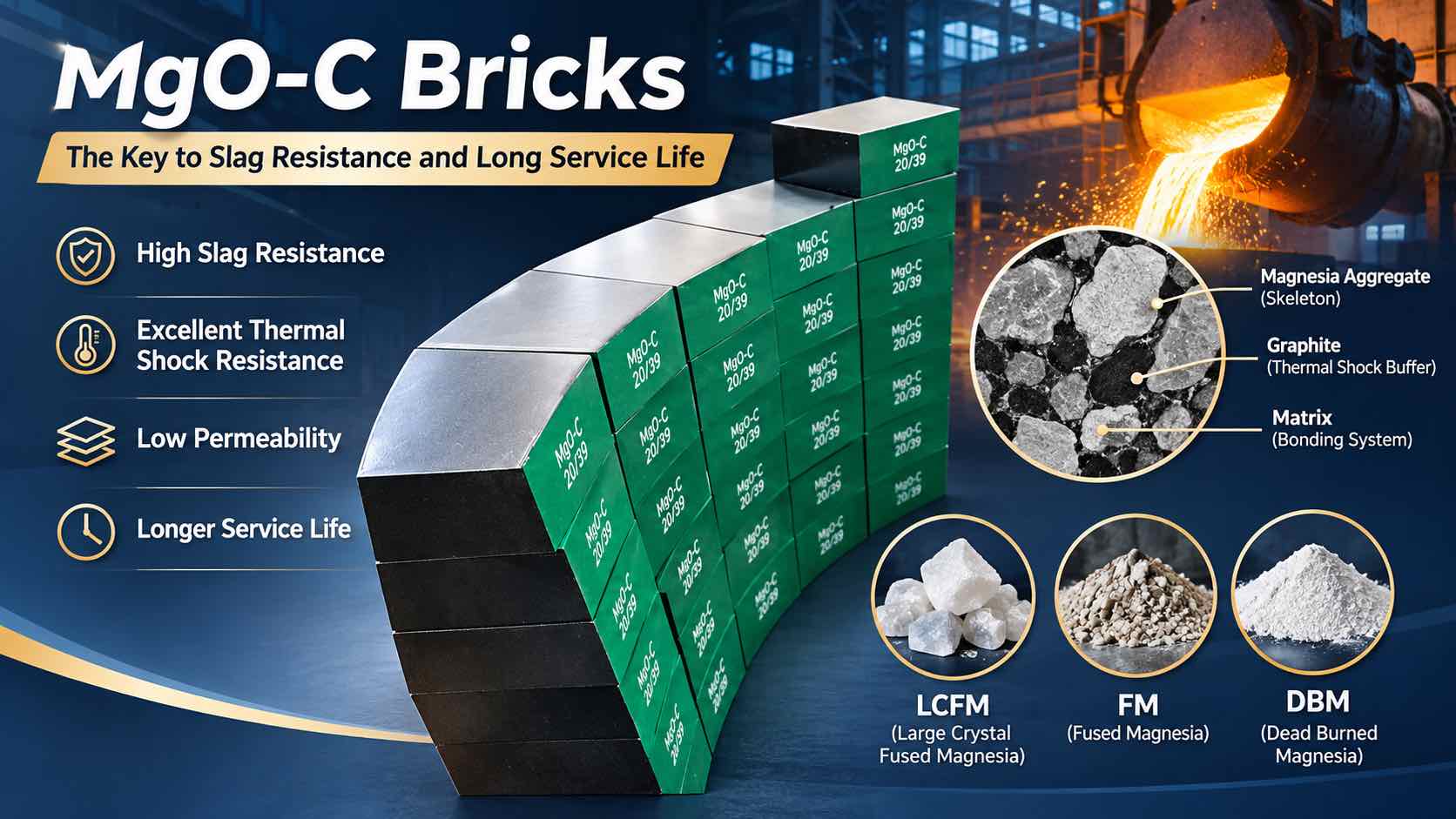
MgO-C Bricks: How Raw Material Quality and Microstructure Design Determine Performance
Understanding the Role of Magnesia, Graphite, Particle Size Distribution and Advanced Refractory Technology
MgO-C (Magnesia-Carbon) bricks are widely used in the steelmaking industry due to their excellent slag resistance, thermal shock resistance, and high-temperature performance. They are commonly applied in steel ladles, especially in slag-line areas, as well as in other demanding refractory applications.
However, not all MgO-C bricks deliver the same performance. Some provide excellent corrosion resistance and long service life, while others experience rapid oxidation, slag penetration, cracking, and premature spalling.
What makes the difference?
The answer goes beyond the chemical composition of individual raw materials. Magnesia quality, graphite characteristics, particle size distribution, bonding systems, and microstructure design all play essential roles in determining the final performance of MgO-C bricks.
1. Magnesia Quality: The Foundation of MgO-C Bricks
Magnesia aggregates form the main refractory skeleton of MgO-C bricks. Their quality directly influences high-temperature stability, corrosion resistance, and structural integrity.
Among the important raw materials used in high-performance MgO-C bricks is Large Crystal Fused Magnesia (LCFM).
Produced through electric arc furnace melting and crystallization, fused magnesia is characterized by:
* Large periclase crystal structures
* High density
* A relatively compact microstructure
* Good resistance to high-temperature slag corrosion
Large-crystal fused magnesia offers particular advantages in demanding refractory applications where corrosion resistance and structural stability are important.
Its large crystal structure can reduce grain-boundary exposure in comparable microstructures. Since grain boundaries may provide pathways for slag penetration and chemical reactions, controlling crystal structure is an important consideration in refractory design.
This makes LCFM a valuable raw material for high-performance MgO-C bricks, particularly in steel ladle slag-line applications.
2. Particle Size Distribution: Building a Stable Internal Structure
Using only coarse magnesia aggregates does not guarantee the best refractory performance.
Although coarse particles establish the structural framework, excessive gaps between them can increase porosity, reduce strength, and provide easier pathways for slag penetration.
A carefully designed particle size distribution is therefore essential.
A typical multi-size grading system includes:
* Coarse aggregates: Establish the main structural skeleton.
* Medium particles: Fill the gaps between coarse aggregates.
* Fine particles: Improve particle packing and structural uniformity.
* Micronized powders: Optimize the matrix and bonding structure.
The objective is to achieve a dense, uniform, and stable microstructure.
However, maximum density does not automatically mean maximum performance. An appropriate pore structure is also important for accommodating thermal stress and maintaining structural stability.
The key is to achieve a balance between density, porosity, strength, and thermal shock resistance.
3. Graphite: An Essential Component for Refractory Performance
Graphite is another critical component in MgO-C bricks.
Its main functions include:
* Improving resistance to slag penetration.
* Reducing slag wetting.
* Increasing thermal conductivity.
* Improving thermal shock resistance.
* Helping accommodate thermal stress through its layered structure.
Graphite has a relatively high thermal conductivity and a layered crystal structure that allows sliding between layers. These characteristics help reduce temperature gradients and stress concentrations within refractory bricks.
Why Does Graphite Particle Size Matter?
Different graphite particle sizes can influence the overall performance of MgO-C bricks.
Larger graphite flakes:
* Can improve resistance to slag penetration.
* Contribute to thermal conductivity.
* Can enhance thermal shock performance.
* Require careful control to ensure uniform distribution and adequate strength.
Smaller graphite particles:
* Help improve distribution throughout the matrix.
* Can contribute to a more uniform microstructure.
* May have higher oxidation susceptibility due to their larger specific surface area.
Therefore, selecting and combining different graphite particle sizes according to the intended application is an important part of MgO-C brick formulation.
The objective is to achieve a well-distributed carbon phase and balanced overall performance.
4. Low-Carbon MgO-C Bricks: A Growing Challenge
As steelmakers increasingly demand cleaner steel and lower carbon pickup, refractory manufacturers face growing pressure to reduce the carbon content of refractory products without sacrificing performance.
Reducing graphite content can affect several important properties, including:
* Slag resistance
* Oxidation resistance
* Thermal shock resistance
* Resistance to slag penetration
To address these challenges, advanced technologies are being developed, including:
* Nano-carbon materials
* Nano-oxide additives
* Ultra-fine powders
* Metallic antioxidants
These technologies aim to improve microstructure, enhance oxidation resistance, and maintain the performance of low-carbon MgO-C bricks.
The development of high-performance low-carbon and ultra-low-carbon MgO-C bricks is becoming an important direction in modern refractory technology.
5. Bonding Systems and Heating Conditions
The bonding system also plays an important role in MgO-C brick performance.
Resin-bonded MgO-C bricks undergo significant structural changes during heating. As the resin decomposes and carbonization takes place, the bonding structure evolves.
During certain temperature ranges, the brick may temporarily experience reduced strength before a more stable carbon-bonded structure develops.
If heating is too rapid or oxidation conditions are unfavorable, problems may include:
* Surface oxidation
* Cracking
* Edge damage
* Powdering and structural weakening
For this reason, appropriate preheating and drying schedules are essential for maintaining refractory integrity and achieving reliable service performance.
6. Post-Service Analysis: Understanding Why Refractory Bricks Fail
When MgO-C bricks fail in service, simply observing cracks or surface damage is not enough.
A proper post-service analysis should examine several important features:
* Crack direction and distribution
* Oxidation layer thickness
* Graphite depletion depth
* Slag penetration depth
* Grain boundary corrosion
* Structural delamination
* Changes in the hot-face microstructure
These observations help identify the dominant failure mechanisms, which may include oxidation, thermal shock, slag corrosion, mechanical erosion, or a combination of several factors.
Understanding the actual failure mechanism is essential for improving refractory formulations, selecting suitable raw materials, and extending service life.
7. Choosing the Right Magnesia Raw Materials for MgO-C Brick Production
The performance of MgO-C bricks depends heavily on the quality and compatibility of their raw materials.
Important considerations include:
* MgO content and chemical purity
* Crystal size and microstructure
* Bulk density
* Impurity levels
* Particle size distribution
* Compatibility with graphite and the bonding system
Different grades of magnesia raw materials serve different purposes depending on the brick formulation and operating conditions.
At China Minerals (Yingkou) Magnesia Co., Ltd., we supply a range of magnesia raw materials for refractory manufacturing, including:
* Dead Burned Magnesia (DBM): Available in different MgO grades for various refractory applications.
* Fused Magnesia (FM): Used in demanding applications requiring high-temperature stability and corrosion resistance.
* Large Crystal Fused Magnesia (LCFM): Suitable for high-performance refractory formulations requiring large periclase crystals and a compact structure.
Selecting the appropriate raw materials is an important step toward achieving consistent product quality and reliable refractory performance.
Conclusion: Better Raw Materials, Better Refractory Solutions
High-performance MgO-C bricks are not simply the result of mixing high-purity magnesia with graphite.
They require a carefully engineered combination of raw material selection, particle size distribution, graphite characteristics, bonding systems, and microstructure design.
For refractory manufacturers, understanding these factors is essential to developing products with improved corrosion resistance, thermal shock resistance, and service life.
Reliable refractory performance starts with reliable raw materials.
Global Cooperation Opportunities
China Minerals (Yingkou) Magnesia Co., Ltd. is committed to supplying quality magnesia raw materials for the global refractory industry.
We welcome long-term cooperation with:
* Refractory manufacturers, especially MgO-C brick producers.
* Local agents and sales representatives.
* Refractory material distributors and trading companies.
* Importers and industrial raw material suppliers.
* Steel mills and other industrial end users.
We are interested in establishing long-term partnerships through local market representation, product distribution, and stable supply relationships.
Looking for a reliable magnesia raw material supplier or a long-term business partner in your market?
Contact us to discuss product specifications, quotations, and potential cooperation opportunities.
Let’s build strong partnerships and grow together in the global refractory industry.